

Maths at Christ Church Academy
At Christ Church Academy, we develop all children with a ‘can-do’ attitude towards maths as well as an appreciation of the beauty and interconnectivity of number. We foster growing levels of self-regulated learning to equip children with the skills they need to solve maths problems. We believe in challenging all pupils to succeed and push themselves to attain a deep and meaningful mathematical understanding. Attainment is not fixed – we can all achieve!
A lesson in Maths:
- 5 minutes warm up (Yr1/2 – ‘Number of the day’; Yr3/4 – Times tables; Yr5/6 – ‘Quick 6’
- KIRFS/Counting – Whole class counting up and down in a variety of ways
- Activate prior knowledge (What have we been working on – examples)
- New learning (Done with the children, not to them – Me / We / You etc.)
- Skill (Concrete à Pictoral à Abstract for their new skill)
- Fluency (Using their new skill in a variety of contexts)
- Reasoning (Explaining concepts and understanding involving their new skill)
All children will have access to the same questions, the same resources and the same support. Different children will require different levels of scaffolds and be able to achieve more or less than other children in a given lesson. They decide for themselves (with occasional direction from the teacher) what they need to help them with that lesson and have free access to this.
A unit of learning:
- Each unit of learning will begin with a ‘prior knowledge harvest’ (derived from the curriculum) showing what the children can already do and where the gaps are. This will inform planning and ensure that all children make progress from their starting points.
- Ensuring that the curriculum is covered, we use ‘small steps’ to ensure that we reduce the risk of cognitive overload. These can be taken from White Rose Maths Hub or Pixl. It is important to make connections between units so that children can understand the interconnectivity of number (e.g. area in multiplication, money in decimals).
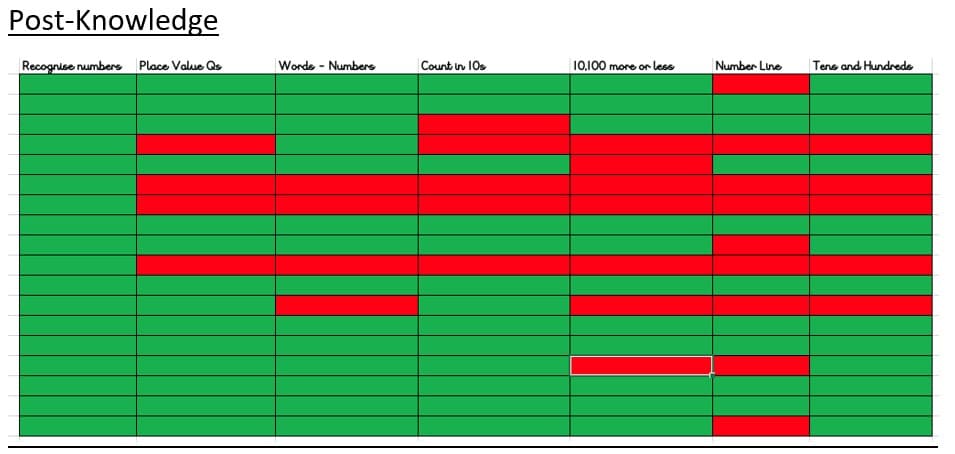
- At least a week after a unit of learning has finished, deliver the ‘post-knowledge harvest’ to assess how much of the unit’s knowledge has been turned into long term memory. When gaps are identified at this point, intervention is put in place.
Arithmetic:
Once a week (usually Friday’s), we practise our arithmetic skills. This can be 5 or 10 questions, or even a full 36-question test. We take real pride in the progress every child makes over the course of the year. Even gaining 1 mark in a week is a cause for massive celebration. These scores are recorded in the child’s book.
CCA KIRFS
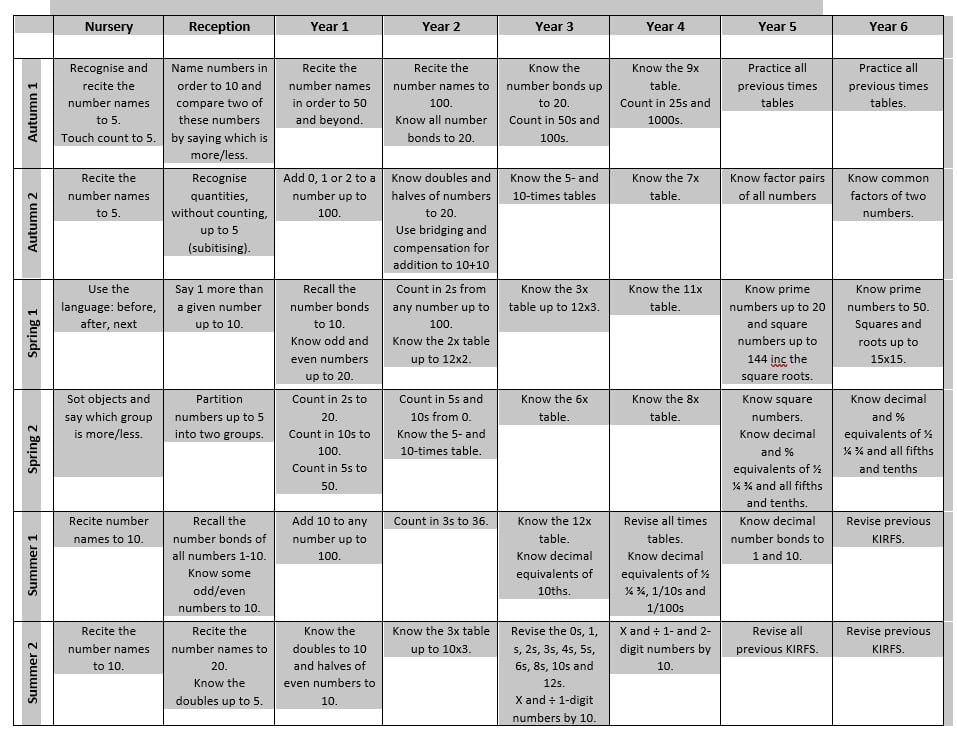
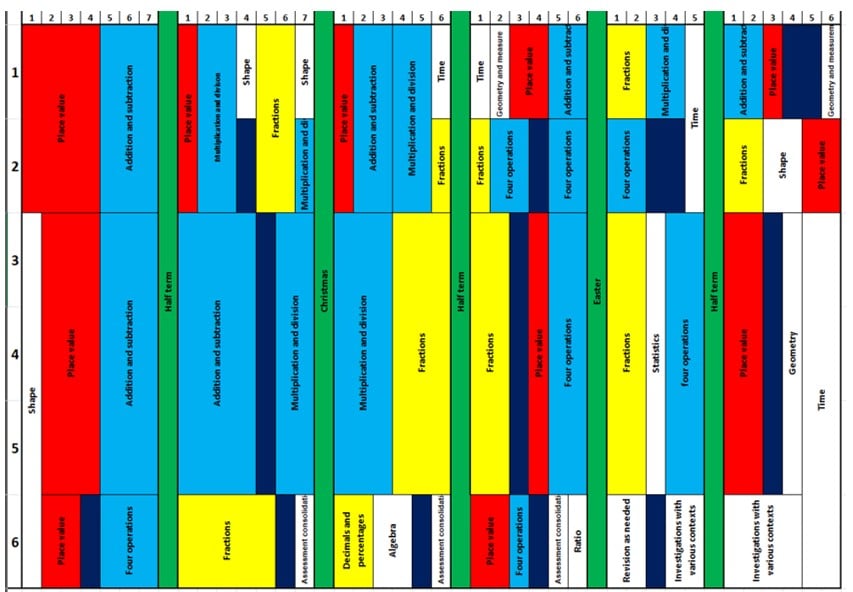
This is our Pace Setting Plan which we follow as a school showing what each class should be doing and when.
Pre and Post Knowledge Harvests
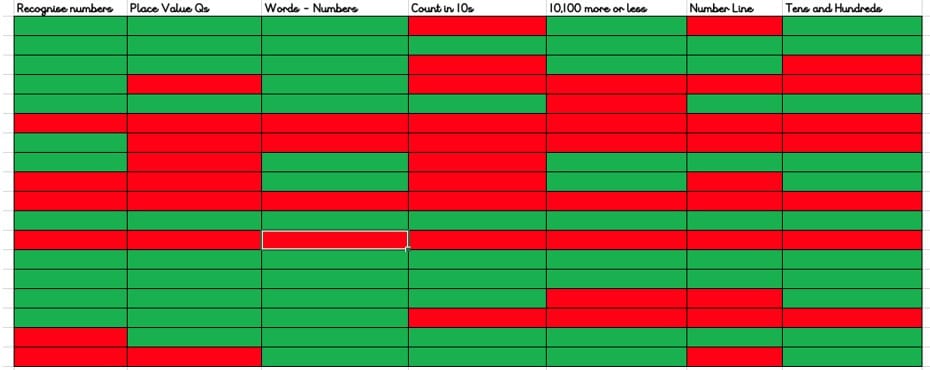
At the beginning of a unit, the children take part in a Pre-Knowledge Harvest, where the children and teacher can see what the children already know and plan according to the unit of work.
Below is an example of a Pre vs Post in one of our classes.
Pre-Knowledge
Times Tables
In KS2, Times Tables are a key ingredient in our Maths lessons. At CCA, lessons all start with our Ashley Downs sheets, 40 questions in 2 minutes. The sheets follow the same pattern for each Times table.
The first set of columns focus on the new facts the children will learn, with a lot of repetition. The next columns reintroduce the other facts previous learned. Finally, the last columns focus on all the times tables that the child will have learned during the scheme.
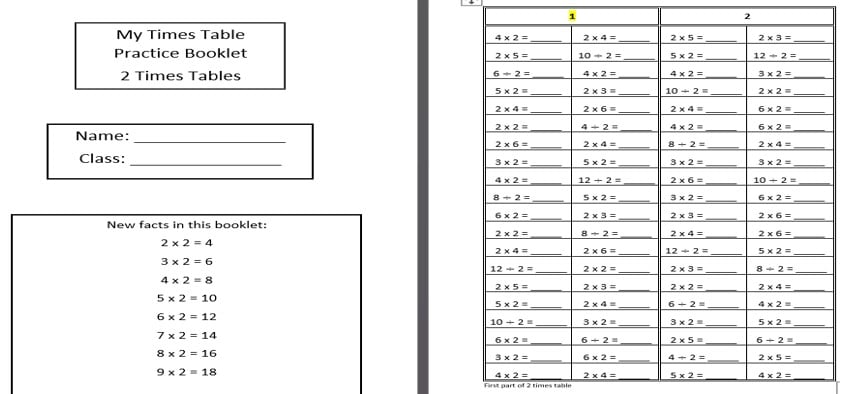
Alongside the daily practice, children are encouraged to practice their Times Tables on TTRockstars.
The new focus for children at CCA is to ‘Go Green’ on all the facts.
Primary maths – Vocabulary progression
For a breakdown in what we learn in each year group, please click these topics:
2 Progression Map Addition and Subtraction
3 Progression Map Multiplication and Division
For a breakdown in what we learn in each year group, please click these topics: